
I built the news app I kept wishing existed
Client
Freelance
Role
Designer and Coder
Tools
Swift, Figma, Adobe Photoshop
Date
March 2026
About this
project
The problem with news apps
Most news apps are built around the same assumption: if you give someone
more, they will stay longer. More stories, more notifications, more
algorithm-driven suggestions designed to keep you scrolling. The business
model depends on attention, which means every design decision gets made
with that in mind, not yours.
I wanted to build something that worked the other way around. News
consumption at its most useful is a quiet, efficient habit. You check in,
get up to speed, and get on with your day. The current generation of apps
actively fights that. They surface the loudest stories, not the most
relevant ones, and they wrap everything in advertising that makes the
experience slower and worse.
RSS already solved the distribution problem years ago. It pulls content
directly from publishers, with no central server in the middle and no ad
layer built into the protocol. The feed arrives clean because there is
nothing in the architecture to make it dirty. SnapDeck is built entirely
on RSS, which means the absence of ads is structural rather than a design
choice someone might reverse later.
Designing around the user, not the feed
The first decision I had to make was what "easy to consume" actually meant
in practice. Reading a news story takes time. Reading forty of them takes
a morning. Most people do not want to read forty stories, they want to
know what is in them, save the ones worth returning to, and move on.
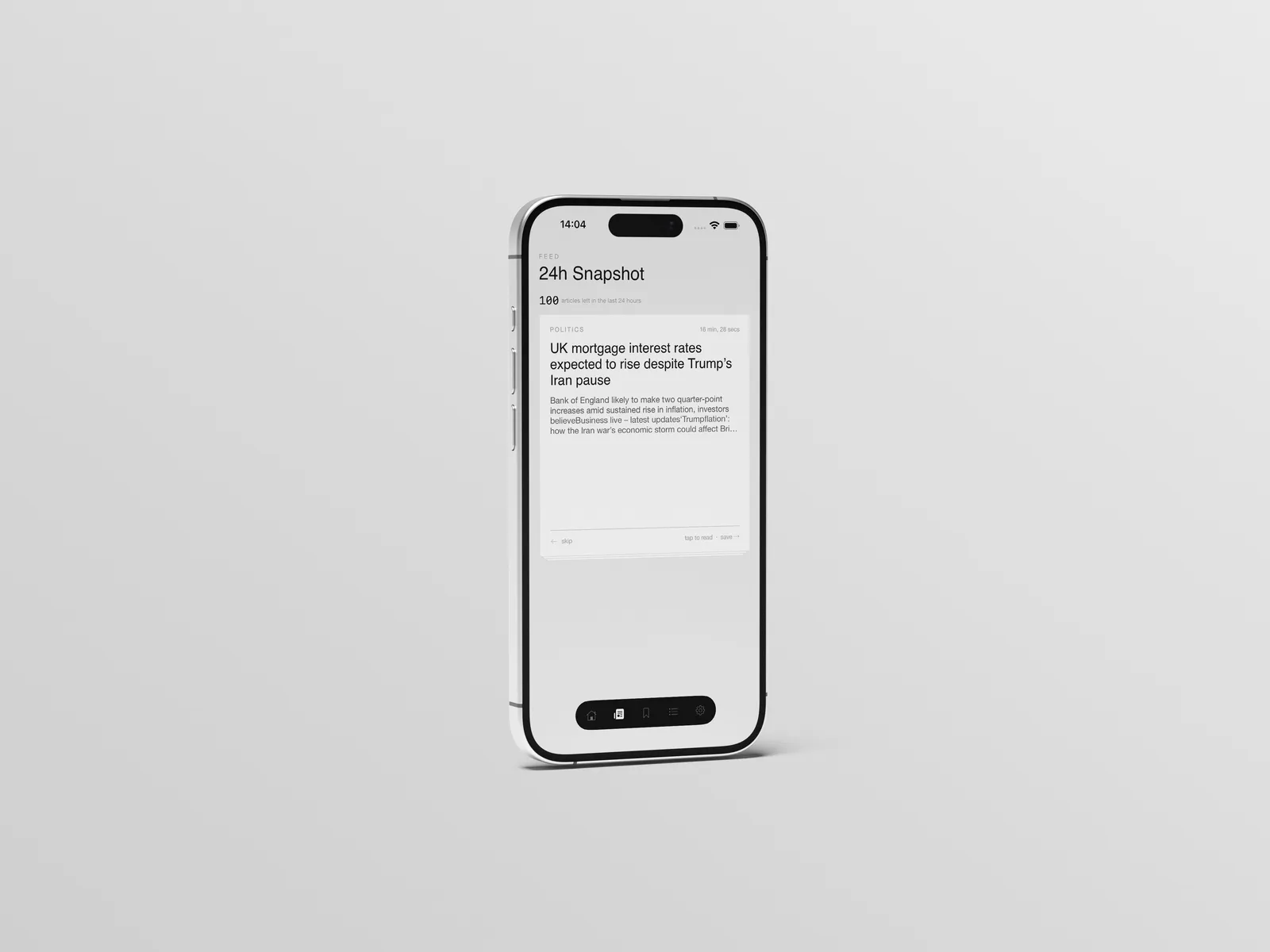
That shaped the entire interaction model. SnapDeck presents one story at
a time in a card format, with enough of the article visible to make a
decision. You swipe to skip, tap to read the full piece in the native
browser, or save it to return to later. The whole flow takes less than a
second per story. You are not scrolling a feed, you are making a series
of small, fast decisions that add up to a genuinely informed read of
the day.
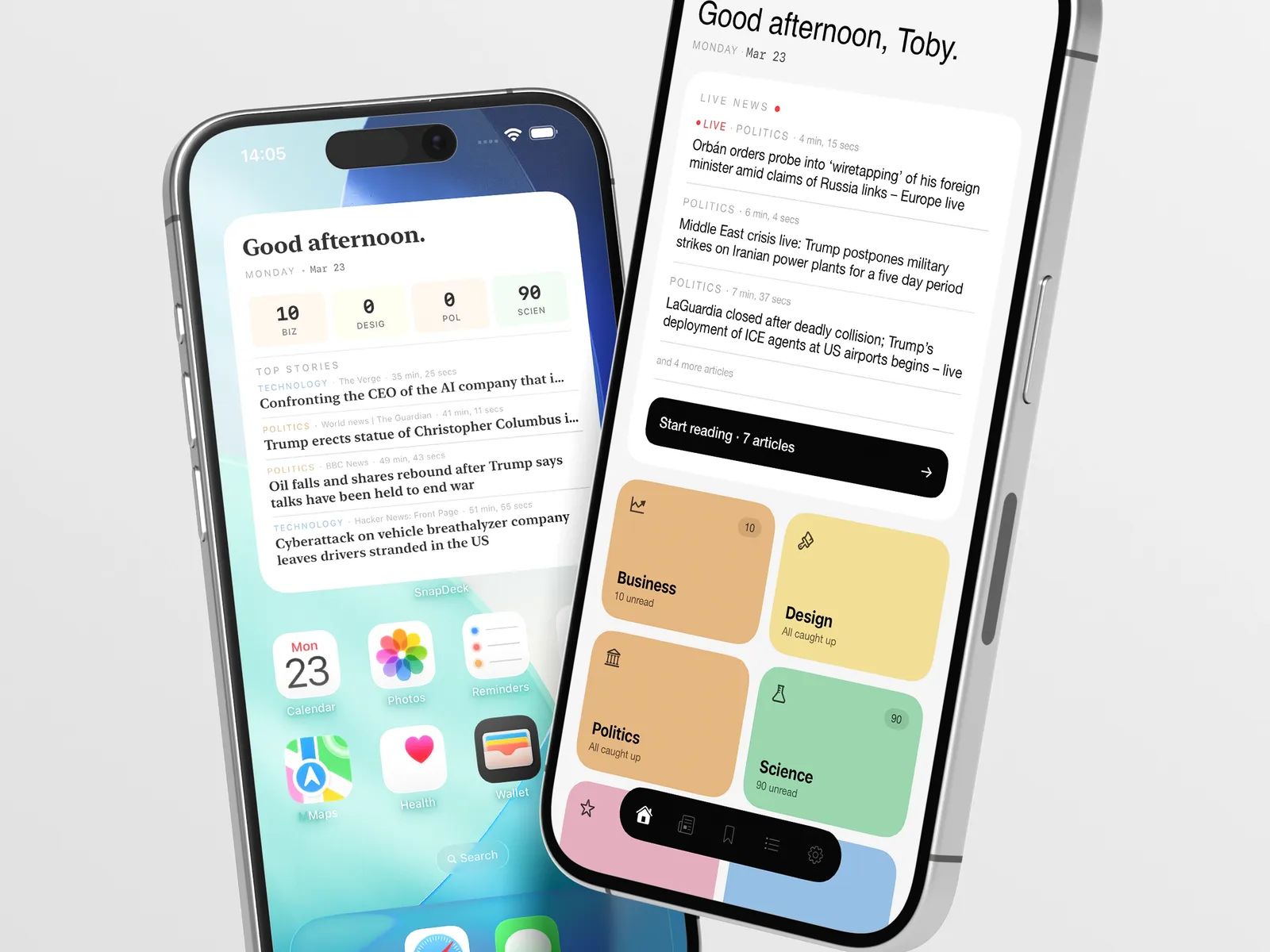
The home screen organises your feeds into topic buckets so you see at a
glance where unread stories are waiting. I built this after noticing that
most RSS readers dump everything into a single chronological list, which
makes the volume feel overwhelming before you have even started. Breaking
stories into categories you have chosen yourself makes the same volume
feel manageable.
Building for iOS with Swift
SnapDeck is written entirely in Swift and designed to feel native on iOS.
I made this decision early and did not revisit it. Cross platform
frameworks solve a real problem if you are building for multiple operating
systems, but they introduce a layer of abstraction that shows up in the
small things: animations that feel slightly wrong, gestures that do not
quite match what iOS users expect, transitions that are close but not right.
The swipe interaction in particular needed to feel physically accurate.
That kind of response is difficult to get right outside of SwiftUI, and
getting it wrong would undermine the whole premise of the app. The entire
user flow is built around the idea that interaction should feel effortless,
and effortless on iOS means feeling like it was made by Apple.
TestFlight Beta: what I learned
I opened TestFlight with a small group of people whose reading habits I
knew well, ranging from people who check the news once a day to people
who had been using RSS readers for years and had opinions about them.
The feedback from the first two weeks was useful in a way that pre-launch
user research rarely is. The swipe mechanic worked immediately for almost
everyone. No one needed to be told how it worked. That was encouraging.
The thing that did not work was the onboarding for RSS feeds. Adding a
feed by URL is standard behaviour for anyone who has used an RSS reader
before, but for people coming from mainstream news apps, it was a friction
point that needed addressing. I added a set of pre-loaded feeds organised
by category so new users could get into the experience without needing to
know what an RSS URL looks like.
I then opened my Beta to the public, within the first 3 days, It has 115
participants willing to contribute crucial feedback to help accelerate
and improve the quality of production.
The other piece of feedback that came up repeatedly was the saving
feature. People wanted to save stories without interrupting the flow
of going through their feed. The original save gesture required a
deliberate tap, which felt like a context switch. I moved it to a
directional swipe so saving sits alongside skip as an equal option,
and the flow stays unbroken.
A subset of testers who were already RSS users were the most engaged
group, unsurprisingly, but their feedback was also the most specific.
They wanted better control over feed refresh intervals and the ability
to mark entire categories as read in one action, not only this, they
wanted the ability to import all their favourite RSS feeds from
the other apps they were using to strictly use mine!
Where I am now
TestFlight is done. The feedback loop ran for four weeks and shaped
the app in ways the initial design did not anticipate, which is exactly
what it is supposed to do. The build is in a state I feel good about
submitting.
App Store review is the next step. SnapDeck does one thing and it does
it without ads, without an account requirement, and without the
algorithmic scaffolding that makes most news apps feel like they are
working against you. Whether that is a straightforward pitch or a
harder one, I will find out soon enough.
 Let's talk about your project!!